
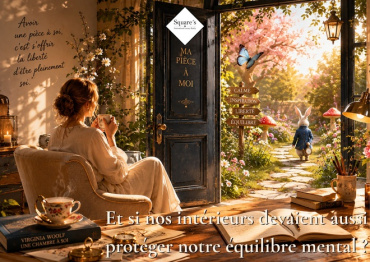
What if our homes also helped protect our mental well-being?
In our increasingly fast-paced lives, we share everything.
Spaces, schedules, notifications, conversations, screens, obligations. Our days often slip by without any real silence, without a moment that’s truly our own.
And yet, one desire comes up more and more often in our conversations: the desire to have a room of one’s own.
A place where we can simply close the door.
Read a few pages in peace, work without interruption, listen to music, reflect, write, or sometimes just… do nothing.
Throughout the interviews conducted for our podcast Cuisine & Confidences, this question came up almost instinctively among many women.
Aurélie Valognes, Perla Servan-Schreiber, and others all spoke, each in their own way, of this need for a personal space, an intimate refuge within the home itself.
So, is this desire deeply feminine?
Or does it ultimately reflect a much more universal need in our contemporary lifestyles?
Virginia Woolf wrote in A Room of One’s Own that having a personal space was an essential condition for thinking, creating, and living fully.
Nearly a century later, this reflection perhaps resonates even more deeply.
Because our interiors have changed.
The home has become, in turn, an office, a meeting room, a reception area, a playroom, and sometimes even a gym. The lines between personal and professional life have gradually blurred.
In this context, having a space of one’s own is no longer just a matter of comfort.
It has become essential for maintaining balance.
A light-filled office, a quiet library, a workshop, a guest room transformed into a sanctuary, a winter garden, or simply a room where one can breathe for a few moments: these spaces have taken on new value today.
Modern luxury may no longer lie solely in square footage or location.
It also lies in the ability to preserve moments of chosen solitude, calm, and self-reflection.
At Square’s International, we see how much this pursuit now influences real estate projects.
Living spaces are no longer designed merely for habitation. They are designed for a better life.
Because, deep down, true balance may simply begin with a door that you can close from time to time.